In August 2025, YouTuber Louis Rossmann started a grassroots solidarity visibility campaign (tentatively named the Clippy Campaign), wherein participants changed their profile pictures on social media platforms in protest of unethical practices by corporations across industries. Users changed their profile pictures to a "Clippy", referring to an image of the "Clippit" avatar of Office Assistant as seen in Microsoft Office from 1997 to 2003.
The movement remains active as of February 2026, as more and more Clippy members find ways to contribute to various causes associated with the movement in their home towns.[1]
Purpose

In recent years, technology companies have been engaging in unethical forms of conduct such as mining personal data to train artificial intelligence without the person's consent, selling personal data to data brokers which are used in invasive advertising, forcing planned obsolescence on products and services where it makes no sense for the user, installing ransomware on devices without the owner's consent, and censoring views of users which they object to. Consumer electronics repair store owner Louis Rossmann uploaded a series of videos on his YouTube channel encouraging his viewers to stand up against these practices.
In the first such video uploaded by Rossmann, he asks viewers to change their profile pictures on their social networking accounts to a picture of a "Clippy" as a form of protest and to provide a way of identifying themselves as a member of the movement. In the following weeks, Clippy profile pictures began flooding YouTube comments sections and started to spread to other sites and applications.
Rossmann has subsequently released further videos addressing the accomplishments that participants have made, the current progress made in different areas, and what members can continue to do in the future to protect people from further overreach by these companies, and even reverse them. His channel has a long history of videos which point out a great number of incidents in which companies have mistreated paying customers, and they have provided members of the movement with valuable information and motivation to change things for the better. Rossmann emphasizes the importance of many people working together, and has pointed out that the Clippy campaign has been much more successful than he has been on his own.[2]
"Clippy" profile pictures

A core element of the movement is using a "Clippy" profile picture, which is an image that resembles the "Clippit" avatar from Office Assistant. Many users modify their avatars to show their commitment to the causes they want to support, resulting in many personalized avatars.
Comparison to "slacktivism"
Another key concept emphasized by Rossmann is preventing the movement from succumbing to slacktivism—in general, the concept refers to proponents of a featured social or political cause doing very little actual work to support what they say they are supporting. The term is a pejorative portmanteau of slacker and activism, and as such implies a negligible level of commitment.[3] Many of Rossmann's videos are focused on ways people can help, because providing examples can provide additional information members can leverage, as well as more motivation on top of that which is garnered through encouraging commentary. Avoiding slacktivism would become a recurring theme throughout future videos (whether named or not).
Clippy as a symbol of escalating overreach
Rossmann uses Clippy to show how technology used to work purely for its intended purpose, in contrast to dark patterns that are now widespread.
Change your profile picture to clippy. I'm serious 1:08
Whether or not you like Clippy, [...] the one thing that you could say—unlike Facebook, who is trying to profit off of young girls that feel suicidal: Clippy simply wanted to help.
He might have been annoying, but he just wanted to help.
There were no ulterior motives.
If you told Clippy you were having a bad day, he wasn't going to use that information to try and figure out which advertiser to sell you to, nor was he trying to steal your personal data to get you to purchase other Microsoft products. He had no ulterior motives, he was simply there to help.
[...] Clippy wouldn't even read the contents of your letter.
The quote demonstrates that Rossmann's choice of using a "Clippy" is a subversion of the increasingly normalized narrative that companies should be able to exploit their customers without it being classified as exploitation. "Clippy" comes from an older era of Microsoft products and services—the Office Assistant software was designed to be helpful above all else, even if users initially had mixed views on it. When compared to Microsoft's current trajectories, "Clippy" stands out in that it never collected user data to sell to advertisers or track people with, while almost all of Microsoft's products and services today do exactly that, and to an increasingly great extent.
Historical parallels
During World War II, in Norway, paperclips were worn like jewelry as a symbol of resistance to German occupation and Norwegian collaboration.[4] They symbolized unity, proclaiming that "we are bound together," much as Rossmann noted that while one paperclip alone is weak, many paperclips (Clippy members) working together are strong together.
Campaign origins
Incipient stage
On 7 August 2025, YouTuber Louis Rossmann uploaded a video titled "Change your profile picture to clippy. I'm serious" and encouraged his viewers to stand up against unethical practices of technology corporations (and companies in other industries) which violated consumer rights or otherwise proved detrimental to their paying customers. In the video, he suggested that members who join the movement could change their profile pictures on YouTube and other platforms to a Clippy, on the grounds that such an avatar was a fitting symbol, that avatars with a common theme would help participants recognize each other, and that the collective usage of the avatar in great numbers would raise questions among others and potentially draw attention to the movement.[5][6]
Rossmann stated that educating the public and spreading awareness of these issues was the primary motivation behind his call to action, and while winning the "legislative battle" would be a favorable end, it was not an imperative end at the first stage of the campaign.[5]
Motivations
The scope of the campaign intersects with the general resistance to anti-ownership practices by companies that have become more common throughout the 2010s and early 2020s, such as denying paying customers the right to repair the products that they had purchased. In the video, Rossmann offered a non-exhaustive list of grievances that people have faced, as possible reasons for aligning with the campaign, shown below in brief (see Examples for details):
- Companies can change the terms of a sale retroactively without legal repercussions.
- Companies can lock users out of a device they already paid for until a novel subscription fee is paid (tantamount to installing ransomware).
- The comments sections of many YouTube channels frequently contain malicious comments that normalize sex trafficking, posted by bot accounts.
- Companies can deny a user's right to repair something damaged in transit (i.e., not by the user), even when the user is willing to purchase needed parts from them, and then threaten legal action for asking them about the decision.
- Companies can conduct psychological experiments on their customers without informed consent, often without legal repercussions.
Early developments
Orientation
Rossmann later uploaded a clarifying video on 12 August 2025, titled "You Changed Your Profile to Clippy: Now What? 📎📎📎", to elaborate on the meaning of the movement for participants and outsiders, and to call participants to action, offering ways in which they could actively contribute to creating effective results that could counteract or make conspicuous the exploitative and dishonest business practices they are protesting. Rossmann stated in the video that the act of changing one's profile picture is not the goal of the movement, but a prerequisite for realizing bigger changes; it serves as a simple task that gets users invested in the movement and increases its visibility, so that even if a participant is not able to effectuate much change on their own, they can make people who are capable of more tangible influence aware of the movement and utilize their assistance.[6] A major focus of the video was slacktivism, which Rossmann asks members to avoid.
You Changed Your Profile to Clippy: Now What? 📎📎📎 1:24
There's this concept called slacktivism, and you'll see it on websites where people are more concerned with punching down than they are with actually trying to clean up their corner of the world because one of them is easy and one of them is not. Slacktivism means doing nothing, and I can imagine the type of person that is using that type of word to insult you because you change your profile picture to a Clippy is the same kind of person who is going to say, "Well, what's the point of putting your key in your car? That's not going to get you to work." Yeah, but it's a prerequisite!
Rossmann encouraged users to deny critics the opportunity to use this term by making real contributions because any member who finds even one way to effectuate real change or make their own contribution, no matter how small, is doing real work with real consequences and therefore invalidating such criticisms (which ties in with the themes of solidarity and strength in numbers).
You Changed Your Profile to Clippy: Now What? 📎📎📎 1:48
[...O]ver the last seven to ten years of trying to advocate for right to repair and thirteen years on YouTube, the one thing I've noticed that is the biggest can't to any type of activism is apathy and believing you're alone.
[...] And the weird thing is, no matter how many times I disprove this, no matter how many times I say, "Look what happens when 10,000 of you email in, we get a bill. Look what happens when email in and do this. Look what happens when you participate here," people still believe that it's hopeless.
[...] And what I was hoping to do is get a different outcome if people realize that there are other people that think like them—that there are other people that are actually willing to do something. I don't plan on just having you people turn your profile pictures to a Clippy to just do that; like, that by itself doesn't do s[---]. What I plan on doing is getting each of you to realize that if you work together, things happen.
He later continues with the clarification by reiterating that anyone at all can make real change, and that no one is alone when everyone identifies together and works together:
You Changed Your Profile to Clippy: Now What? 📎📎📎 7:34
I'm trying to get the ball rolling here. The real thing I want you all to do is: in your personal life, when you come across a time or a situation when you can actually do something, you speak up and you do something. [...T]here's going to be a point in your life where if every single person were on the same page, you could do something that otherwise wouldn't have worked, and change can get created. When everybody's on the same page, and everybody is in agreement as to what the problem is, things just naturally move smoother. I've noticed this in my business, I've noticed this in my nonprofit, and I've noticed this with general activism, and I'm trying to get a little bit of that going.
Early reflections
Rossmann uploaded a follow-up video four days later, on 16 August 2025, titled "Progress of clippy movement one week in", in which he remarked on the rapid growth of the movement and thanked participants for actively working and making a difference, and not simply changing their profile pictures without doing anything else.[7]
Progress of clippy movement one week in 0:32
And I have been very happy, humbled, and honored to see the change that's occurred over the past week. My new nonprofit has a website, consumerrights.wiki. This website is a database of companies that take part in these anti-ownership, anti-consumer practices. It makes it much easier to speak to senators and congresspeople about these issues, as well as to members of the media and be taken seriously when I have a properly, well-cited, referenced, and sourced document that looks like an encyclopedia. [...] The wiki has had an absolute explosion in the past week since doing that Clippy video of people really taking part in all of this, [...] doing the very, very difficult, annoying, pain-in-the-ass work of logging everything [... and making] it infinitely better as a resource. [3:03] And the edits genuinely show how much has changed. Thank you. Thank you so much. You didn't just change your profile picture. You changed your profile picture and you immediately got to work, taking the steps that you can, in your personal life, doing what you can do to try and move towards a world where ownership matters. And it shows.
On 1 September 2025 a fourth video under the title "THIS is what it means to be a clippy", was posted by Rossmann. It questioned his followers and gave examples on how individuals could show integrity and push back and against new age anti-ownership practices in their own lives and what the effects of that decision might be. An important point raised in the video was that users don't have to sacrifice anything to be a part of something bigger, because any small actions, when performed all together by many people, add up to significant results.[8]
Silhouette series
In October 2025, Rossmann began uploading green-screen videos in the style of silhouette interviews, which are used by news broadcasts to keep an interviewee's identity anonymous, but can be used rhetorically outside of news broadcasts to visually represent an anonymous party; in this case, the anonymous party is the collection of editors for Consumer Rights Wiki and members of, or subscribers to, the FULU Foundation.[9] These videos consist of Rossmann depicted as a featureless silhouette, speaking about a specific company's malpractice, and occasionally holding up a large paperclip against the background, symbolizing the collective agreement of the vast number of "Clippy" users online.
On 9 October 2025, Rossmann uploaded his first silhouette video, an annunciatory reaction to recent decisions from the company Synology. The video, titled "Synology reverses course on requiring branded drives: NOT ENOUGH!", begins by dedicating the announcement to restoring consumer rights and the rights of ownership. The core of the video refers to the company formerly requiring users to use only Synology hard drives in their network-attached storage units, a policy enforced by DRM. Synology reversed their decision, but Rossmann points out that it is not enough to simply undo the action; the company has to indicate plainly to its customers that they will not engage in further anti-consumer practices in the future. The video ends with a call to action for members of the Clippy movement, declaring that the fight for consumer rights had moved into a new era, in which companies reverse the detrimental actions which had previously characterized their policies toward their own customers:
Synology reverses course on requiring branded drives: NOT ENOUGH! 2:43
If your favorite influencer starts shilling Synology products again after this product update without telling you their full history, let them know Clippy is watching. [Rossmann's silhouette holds up a large paperclip against the background.] We have entered a new stage of consumer rights: the FAFO era, where companies that take part in these practices reverse them. But it's not enough that they reverse them—they must also repent. Clippy demands repentance. I have not seen this repentance, and therefore I am not satisfied.
On 10 October 2025, Rossmann uploaded a second silhouette video, an open letter to Satya Nadella, the current CEO of Microsoft, titled "Microsoft went too far". He mentions that Windows 11, the newest version of the company's flagship product, has been redesigned to prohibit setup without logging into a Microsoft account online, even if the user never plans on using any online Microsoft services. It is thus no longer possible to use solely local methods (i.e., methods that do not require connecting to an Internet web server) to set up a computer with Windows 11 installed. He then points out the hypocrisy in their policy regarding the operating system's preceding version, Windows 10, and calls on Nadella to take action to correct the company's missteps:
[Reading from AlternativeTo][10] Microsoft says that removing local only methods prevents skipped configuration steps and ensures devices are properly set up and secure. [Commentary] But leaving hundreds of millions of Windows 10 devices without security updates isn't... tell me more!
[Reading] This change is part of the company’s broader "Local-only commands removal" initiative, reinforcing that bypassing account creation could lead to incomplete setups or potential security issues. [...]
[Commentary] Satya Nadella, here are our demands. Number one: provide security updates to Windows 10 on the same terms for United States customers, the people in the country that made you a $3 trillion company, that you provide them to in the EU. Number two: remove this requirement that people connect to the Internet and sign up for an online account with your system in order to use their local operating system. This is unnecessary and just another way to get more people's data. You have enough of their data.
[Rossmann's silhouette holds up a large paperclip against the background.] Clippy would never require an online account to use a word processor or an operating system. Respect the Clippy. He's watching.
Rossmann concludes the video by stating that if Microsoft does not reverse its course by the 16th, then he would hold on the 18th a public event on behalf of the FULU Foundation, where users can get their computers upgraded, learn how to install free software, and try out Linux (a free operating system) for themselves.[11] Rossmann stated that the goal was to encourage people to help other members of their community, learn new ways of keeping their technology safe from viruses, and prevent computers from populating landfills (because many people have to throw out their old computers which are unable to run Windows 11, but replacing Windows with Linux prevents this).
Emergence out in the world
A notable example Rossmann featured of the Clippy movement outside of the Internet comes from a discussion about Vidor, Texas and its city council meeting. Rossmann starts out a video published on 10 October 2025 by recounting the background behind the movement's progress in Vidor and uses it as an example of members uniting together and doing real work. Vidor's city council is presented as not being proactive or willing to investigate for themselves. The video also offers an excellent anecdote about the growing culture associated with the movement as word spreads online.
Vidor, Texas says no to Flock AI surveillance traffic cameras 0:11
Somebody reached out to me [...] saying, "I watched your video on what you did at Austin and I wanted to see if they had these cameras in my city." So, she looked it up, and what do you know? They were on the next city council meeting. They didn't get back to her, so she showed up and gave them a piece of her mind. She did a really good job and I wanted to play you that [...] and everything that everybody else said. [...] I'm really proud of it. As I said with what we're trying to do with the Clippy movement: it's not about just changing your profile picture to let people know you're not happy. It's about pushing back everywhere that you can in your own corner of the world in everyday life. Did they get it removed for good? No. But they got it tabled. Their town is not spending $60,000 to put up cameras with AI that surveilled them everywhere they go and save the information on somebody else's server. I think that's a great step forward. Screw Flock. I don't want that stuff in my city, and I also don't want it in yours. And if you want to help try to get out of your city, I will help you as much as humanly possible.
[3:03 The aforementioned woman speaks to Rossmann, accompanied by her husband.] My city council is not going to pay attention unless they have hard facts in front of them. I specifically emailed everybody of the city council and I received no response. So that—
ROSSMANN: Wait, so your city council sounds like our city council.
WIFE: Mhm, which is why I am now forcing my husband—we are moving in town, and the next opportunity I have after research, I am going to be running for city council because I am tired—
ROSSMANN: No way!
WIFE: —of the efficiency of it.
HUSBAND: Also, for your journeys, 'cause one thing I could not find online was a... a version of Clippy that you could actually cut out of vinyl, so I had to figure out how to make an SVG, and I got twenty of them. I cut them for you.
ROSSMANN: No way!
HUSBAND: Yes.
ROSSMANN: Thank you.
HUSBAND: Yes!
ROSSMANN: Thank you so much. This makes me happy.
HUSBAND: And that, directly, is inspired by the post from Denton. The "Clippy is watching."? I was like, I got to do that. I got to make it.
WIFE: He put the vinyl on my car. The back... the back window.
HUSBAND: Eighty inches of vinyl.
Impact
Rossmann hopes that the group awareness created by the campaign will allow people to take action more quickly, due to already knowing that others around them are in alignment. Already it has been seen that many users on YouTube and other social media sites have taken part in the campaign. Some are even taking action to further spread word of the movement in hopes it will eventually get the attention of legislation, tech companies, etc.
You Changed Your Profile to Clippy: Now What? 📎📎📎 4:25
But if all of them know at the same time that we're on the same page:
We are tired of living in an anti-ownership society—check.
We are tired of living in a society where we subscribe to everything and we own nothing—check.
We are tired of being told it cost $8,000 to fix a f[---]ing power button—check.
[...]
If every single one of these people were not only on the same page, but knew they were on the same page, maybe each one in the chain would speak up when they otherwise wouldn't.
And when they're all moving together and all working together, what happens?
They choose a different vendor.
Within one week, there has already been visible progress due to this movement; namely, an increase in edits to consumerrights.wiki.
Progress of clippy movement one week in 1:06
We have something called Plausible. It's GDPR privacy-preserving analytics. [...Y]ou can see this jump over here [around 11 Aug] [...] also coincides with many articles that were incomplete, being edited to the point of being perfect[...]
As well as tangible progress outside of this wiki, the point of the movement is to encourage changes in individual lives so that these small changes accumulate:
Progress of clippy movement one week in 1:56
[A]nd I'm very excited, not just by this, but by all of the emails that I've received from you, where you've told me in your own personal life where you made a different decision to try and make a difference.
According to Rossmann, the point of the Clippy campaign is for members to effectuate change in the world wherever they see it necessary—even if it is a small change, everyone's small changes together add up to much greater change. Rossmann describes this as "cleaning up your corner of the world." Since the beginning of the campaign, there have been many instances of larger changes manifested by the unity of the community.
Vidor, Texas refuses AI surveillance
This section is incomplete. This notice can be deleted once all the placeholder text has been replaced.
At the 9 October 2025 Vidor, Texas city council meeting, many Clippy members showed up to voice their concerns about item C-13, which involved AI-powered surveillance cameras.
Austin, Texas
This section is incomplete. This notice can be deleted once all the placeholder text has been replaced.
Austin, Texas has been a site of particularly high activity in the movement.
Bose audio equipment
This section is incomplete. This notice can be deleted once all the placeholder text has been replaced.
Bose employees walked back an anti-consumer policy after Clippy members reached out.
Flock AI surveillance
This section is incomplete. This notice can be deleted once all the placeholder text has been replaced.
City council meetings
This section is incomplete. This notice can be deleted once all the placeholder text has been replaced.
Examples of anti-consumer practices
Rossmann provided some examples of motivations people might have to join the campaign in his first video. This is only a list of the example from that video; further examples can be found in hundreds of other videos posted on Rossmann's channel.
- Companies can change the terms of a sale retroactively without legal repercussions. The example offered is Philips Hue changing the terms of service on smart light bulbs that were already purchased under different terms, thence requiring users to sign up for an account in order to use the light bulbs.[12][13][14]
- Companies can lock users out of a device they already paid for until a novel subscription fee is paid (tantamount to ransomware). The example offered is the smart-home company Futurehome pushing out a firmware update that disabled the smart-home devices of every customer; devices could only be re-enabled if the customer signed up for a new subscription that was not previously required.[15][16]
- The comments sections of many YouTube channels frequently contain malicious comments that normalize sex trafficking, posted by bot accounts.[5] Massive botnets create autonomous accounts with profile pictures ostensibly featuring attractive or scantily dressed women, and when their channels are viewed, the user is greeted with links to websites that contain adult content, enticing users to fall for phishing scams.[17]. Such comments are extremely pervasive, often showing up just seconds after a video is uploaded, seemingly only ever deleted by the manual review of the owner of the video rather than by server-side action; their extent is met contrariwise by reports of legitimate comments from real users being completely censored (not being visible to anyone other than the poster of the comment), even including the user who uploaded the video itself.[citation needed] Rossmann points out in the aforementioned video that some of these bot accounts can bypass the filters by using pictures that are not actually of scantily dressed women, but can so appear to be when the image is small, such as when it is beside a comment; only when it is examined more closely, can it be shown to be an image of something else, such as a cat next to some pillows.[5]
- Companies can deny a user's right to repair something damaged in transit (i.e., not by the user), even when the user is willing to purchase needed parts from them, and then threaten legal action for asking them about the decision. The example offered is Cami Research accusing a user of harassment who was very professional over the phone, outright stating that because it values profit over users being able to repair products which they already purchased, it does not want customers to be able to repair them because if they repair the unit they already have, they would not buy a new one.[18]
- Companies can conduct psychological experiments on their customers without their consent, without legal repercussions. The example offered is Tado, a company that makes smart thermostats, which added a paywall to their devices, demanding a subscription fee, after customers had already bought their product (where the terms of the sale at the time of purchase indicated that there was no subscription fee). The paywall was actually fake; its purpose was to see how many customers would willingly go along with the additional payments. In essence, the company threatened to remove a service to induce a behavior on their customers.[19] This is another example of retroactive amendments to the terms of products and services already sold in completion (see first point above).
Slogan
Clippy just wanted to help.
Gallery
-
 A CC-0 (public domain) 3D model based on Clippy
 -
 The original Clippy render
 -
 Someone's custom Clippy render
 -
 Clippy render against a blue background
 -
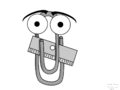 Look a cute clippy who accidentally broke pencil sharpener and is now trying to hide evidence!
 -
 A custom Clippy .SVG file for general use, such as avatars, etcetera


References
- ↑ "You protested AI surveillance cameras & Austin wrote a law because of it!". 3 Feb 2026. Archived from the original on 4 Feb 2026.
- ↑ "DO THE WORK!". 4 Feb 2026. Archived from the original on 5 Feb 2026.
- ↑ "(PDF) Activism or Slacktivism? The Potential and Pitfalls of Social Media in Contemporary Student Activism". 2017. Archived from the original on 4 Aug 2021.
- ↑ Schlesinger, Joe (August 5, 2011). "Breivik, Quisling and the Norwegian spirit". Canadian Broadcasting Corporation|CBC. Archived from the original on 11 Apr 2021. Retrieved 13 Sep 2025.
- ↑ 5.0 5.1 5.2 5.3 "Change your profile picture to clippy. I'm serious". 7 Aug 2025. Archived from the original on 7 Aug 2025.
- ↑ 6.0 6.1 "You Changed Your Profile to Clippy: Now What? 📎📎📎". 12 Aug 2025. Archived from the original on 12 Aug 2025.
- ↑ "Progress of clippy movement one week in". 16 Aug 2025. Archived from the original on 16 Aug 2025.
- ↑ "THIS is what it means to be a clippy". 1 Sep 2025. Archived from the original on 2 Sep 2025.
- ↑ "Synology reverses course on requiring branded drives: NOT ENOUGH!". 9 Oct 2025. Archived from the original on 9 Oct 2025.
- ↑ "Windows 11 removes all bypass methods for Microsoft account setup, removing local accounts". 7 Oct 2025. Archived from the original on 7 Oct 2025.
- ↑ "Microsoft went too far". 10 Oct 2025. Archived from the original on 10 Oct 2025.
- ↑ "Philips changes terms after the sale: requires data-sharing account to use a light bulb..." 25 Sep 2023. Archived from the original on 25 Sep 2023.
- ↑ "Philips Hue soon only usable with account". 21 Sep 2023. Archived from the original on 26 Sep 2023.
- ↑ "Philips Hue will force users to upload their data to Hue cloud". 22 Sep 2023. Archived from the original on 3 Nov 2023.
- ↑ "Smarthome company goes bankrupt, new owner ransoms everyone's house: $5000 bounty to crack firmware!". 16 Jul 2025. Archived from the original on 16 Jul 2025.
- ↑ "Futurehome proves why it's more important than ever to take back control of your smart home". 31 Jul 2025. Archived from the original on 31 Jul 2025.
- ↑ "My YouTube Channel's Comment Section is Infested By Bots!". 20 May 2025. Archived from the original on 22 Jun 2025.
- ↑ "Cami Research blatantly violates Oregon Right to Repair Law, Oregon DOJ does nothing". 21 Jun 2025. Archived from the original on 22 Jun 2025.
- ↑ "Thermostat maker performs psychological experiments on customers: never buy Tado products". 21 Feb 2025. Archived from the original on 21 Feb 2025.
External links
- Clippy Builder — a generator for a custom Clippy profile pic
- Videos by other YouTubers remarking on the Clippy campaign: