⚠️This article has been marked as incomplete. Sourcing or verifiability needs additional work.
#appeals channel in either Zulip or Discord to request removal.Articles must provide verifiable, credible evidence for their claims and avoid relying on forum posts, personal blogs, or other unverifiable sources. You can help by replacing weak citations with reputable reporting, corporate communications, receipts, repair logs, or independent investigative coverage that demonstrates the systemic relevance required by the Mission statement and Moderator Guidelines.
A dark pattern is an umbrella term for all deceptive tricks faced by consumers, and it relies on behavioral psychology and human biases in order to make the user act against their own intent, like buying or signing up for something.[1]
Dark patterns can be found can be found across industries,[2] but most often in mobile interfaces. A 2022 European Commission report indicated that 97% of popular mobile apps used by EU consumers have them.[3] And a 2019 study found approximately 1/10th out of 11,000 e-commerce websites have them.[4]
The term dark patterns was originally defined by Harry Brignull as "design tricks that manipulate users into taking actions they didn't intend to." This wording was later rebranded to the deceptive design.[1] The Federal Trade Commission (FTC) describes them as "design practices that trick or manipulate users into making choices they would not otherwise have made and that may cause harm."[5] benefiting the service provider through manipulation.
How it works
Dark patterns trick users by taking advantage of unconscious thoughts. For example, in cookie banners the "Accept All" option is the first option listed and uses a green background. People tend to choose the first option before considering others. Green is associated with good in design. In cookie banners, there is also a "Manage my choices" option that typically involves opting out of each data collection category or website one at a time. It is easier for users to accept all cookies than to decline them, due to using dark patterns.[6][7]
Examples
Research suggest that there are 60+ types of deceptive design, so below are a few examples.[2]
You can view cases and types of dark patterns documented in the wiki by visiting the Dark patterns category
Obstruction patterns
These designs make desired actions (like rejecting tracking) significantly more difficult than accepting alternatives. A classic example is the Roach Motel pattern, where signing up for a service is straightforward but cancellation is excessively difficult. The FTC highlighted this pattern in their case against ABCmouse, where cancellation was made "extremely difficult" despite promising "Easy Cancellation".[8]
Interface interference
This category includes designs that manipulate interface elements to steer user behavior. Misdirection focuses user attention on one element to obscure another critical detail. Disguised ads blend advertisements with genuine interface elements, like fake "Download" buttons on software websites.[5]
Forced action
These patterns require users to complete unnecessary actions to access desired functionality. Forced registration demands that users create an account to complete a task. Forced continuity involves automatically transitioning users from free trials to paid subscriptions without adequate notification. The FTC alleged that Adobe violated regulations by "tricking customers into enrolling in subscription plans without proper disclosure".[5][9]
Sneaking and information hiding
These practices involve concealing or obscuring material information from users, such as
- Hidden costs reveal unexpected fees only at checkout, a practice employed by ticketing platforms
- Drip pricing advertises only part of a product's total price initially and then imposes other mandatory charges later[5]
- Checking a box by default that installs potentially-unwanted software, such as an "anti-virus" that's actually spyware or a crypto-miner
Social proof and urgency
- Main article: Fear of missing out
These patterns exploit social influence and time pressure to manipulate decisions. False activity messages misrepresent site activity or product popularity. False scarcity creates pressure to buy immediately by claiming limited inventory, or baseless countdown timers that reset when expired.
False choice
This category includes any form of providing 2 or more "options" or "choices" to the user (each one with pros and cons), but only one or a few of them are reasonable and/or pragmatic. A more specific subset of this category, consists on providing extremely coarse ("all or nothing") choices. Examples:
- Cookie prompts where the only choices are "Accept all" and "Reject all". If the user clicks "Reject", they have to login everytime they switch to a different page, and none of their settings/preferences are saved. If the user clicks "Accept", they get tracked by several third-parties.
- Android doesn't consider
INTERNETas a "dangerous" permission, so users can only enable or disable internet access for all apps.
Like many types of dark patterns, there is malicious compliance when the responsible subject is faced with legal pressure to comply with pro-consumer regulations.
Legal and regulatory landscape
United States framework
In the United States, regulation occurs primarily through existing consumer protection statutes. The FTC Act empowers the Federal Trade Commission to take action against "unfair or deceptive acts or practices in or affecting commerce".[10]
In October 2024, the FTC amended its Negative Option Rule to include specific requirements for cancellation mechanisms, implementing a "Click-to-Cancel" provision.[11] The FTC later voted on 9 May 2025 to extend the original 14 May 2025 compliance deadline by sixty days.[12][13]
On 8 July 2025, the Eighth Circuit Court of Appeals vacated the entire 2024 change to the Negative Option Rule on procedural grounds in Custom Communications, Inc. v. Federal Trade Commission.[14][15] Despite the legal setback, the FTC carried out findings against Match.com, Chegg Inc., Cleo AI and Amazon based on the Restore Online Shoppers' Confidence Act (ROSCA) and Section 5 of the FTC Act.[16]
On 30 January 2026, the FTC indicated renewed interest in updating the Negative Option Rule by submitting a draft Advance Notice of Proposed Rulemaking (ANPRM) to the Office of Management and Budget (OMB) for review.[17][18] It was opened to public comment on 11 March 2026.[19]
European Union's approach
The European approach combines general consumer protection laws with data privacy-specific regulations. While the General Data Protection Regulation (GDPR) doesn't explicitly mention dark patterns, its requirements for valid consent effectively prohibit many deceptive designs.[20]
The Digital Services Act (DSA) and Digital Markets Act (DMA) further address dark patterns by prohibiting practices that "deceive or manipulate" users.[21]
Enforcement cases and penalties
Recent years have seen significant enforcement actions:
- Epic Games paid $245 million to settle charges related to deceptive patterns in Fortnite.[22]
- Noom paid $62 million to settle charges regarding deceptive subscription practices.[23]
- TikTok received a €345 million fine for failing to protect children's data through manipulative consent practices.[24]
Indirect harms
The base motivation of deceptive design is to create more benefits for the company. But there are several indirect harms done in the process, some of them listed below.
Consumers
A dark pattern is harmful to consumers in many ways, often leading to financial loss and emotional distress.[citation needed - Needs some study or news site here]
They could also be used violate the consumers privacy by hiding information on what data a service collects and how that data is used, and hiding or excluding options to stop data collection or delete already collected data.
Dark patterns attempt to frustrate the consumer enough to accept what patterns are being used against them, and stop looking for any in-site settings or other methods to bypass the patterns.[5][20] This can train up a feeling of hopelessness or cynisim over time.
The most vulnerable consumers are those who are unfamiliar with computers and the internet, and those with mental or physical disabilities that impair them from either recognizing dark patterns or avoiding them if possible. People with anxiety disorders are also easier victims of deceptive design, especially because fear some types of deceptive design directly rely on injecting fear and stress.
Businesses
Despite consumer backlash being unlikely to lead to immediate change in business practices, many dark patterns that violate consumer protection laws could lead to heavy lawsuits against businesses[5] People can also start to avoid a brand based on a deceptive experience with a particular product, because they have lost trust with them. And the more companies do these kinds of practices the more this causes the erosion of trust in businesses in general. A societal effect like this can have significant business and economic implications.
Mitigation
Transparency and advocacy
Consumer education plays a crucial role. Initiatives like the Dark Patterns Tip Line allow users to report deceptive designs they encounter. Advocacy organizations provide resources to help identify and avoid dark patterns.[1]
Designers should implement neutral default settings that don't assume consent.[7] And companies should provide honest explanations of data practices and costs in clear, understandable language.
Detection tools
Efforts to automatically detect dark patterns are evolving but face significant challenges. A comprehensive study found that existing tools could only identify 31 of 68 identified dark pattern types, a coverage rate of just 45.5%.[2] The study proposed a Dark Pattern Analysis Framework (DPAF) to address existing gaps.
Gallery
Examples of dark patterns.
Carly
-
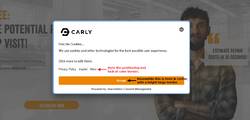 An example of manipulating the user by minimizing the noticeability of the "More" option while emphasizing only the "Accept" button.

-
 The message that appears on user's visit to the website. Cookie management is located closely above the bright Continue button.
 -
 "Do not sell or share" is enabled by default, but comes with a disclaimer. (See file page for further notes.)


-
 The most expensive plan is selected by default and has a colorful display to immediately draw the user's eye to it. The cheaper options are de-emphasized.

References
- ↑ 1.0 1.1 1.2 Brignull, Harry; Leiser, Mark; et al. (25 Apr 2023). "Dark Patterns: inside the interfaces designed to trick you". Deceptive.Design. Archived from the original on 22 Mar 2026. Retrieved 22 Mar 2026.
- ↑ 2.0 2.1 2.2 Li, Meng; Wang, Xiang; Nei, Liming; Li, Chenglin; Liu, Yang; Zhao, Yangyang; Xue, Lei; Kabir Sulaiman, Said (2024-12-12). "[2412.09147] A Comprehensive Study on Dark Patterns". arXiv. doi:10.48550/arXiv.2412.09147. Archived from the original on 9 Nov 2025. Retrieved 2025-11-08.
- ↑ Lupiáñez-Villanueva, Francisco; Boluda, Alba; et al. (Apr 2022). "Behavioural study on unfair commercial practices in the digital environment". Publications Office of the EU. doi:10.2838/859030. ISBN 978-92-76-52316-1. Archived from the original on 18 Jan 2026. Retrieved 22 Mar 2026.
- ↑ Cimpanu, Catalin (11 Nov 2019). "Study of over 11,000 online stores finds 'dark patterns' on 1,254 sites". ZDNET. Archived from the original on 14 Nov 2025. Retrieved 8 Nov 2025.
- ↑ 5.0 5.1 5.2 5.3 5.4 5.5 "Bringing Dark Patterns to Light". Federal Trade Commission. Sep 2022. Archived from the original on 9 Dec 2025. Retrieved 22 Mar 2026.
- ↑ Stroink-Skillrud, Donata (2 Feb 2023). "Your Cookie Consent Banner is (Probably) Not Compliant". MainWP. Archived from the original on 16 Feb 2026. Retrieved 22 Mar 2026.
- ↑ 7.0 7.1 Keyser, Robert (2023-10-05). "Cookie Consent Dark Patterns: How to Identify and Fix Them". Ethyca. Archived from the original on 12 Dec 2025. Retrieved 2025-08-11.
- ↑ Keller and Heckman LLP (28 Sep 2020). "FTC Targets Negative Option Schemes in Two Multimillion Dollar Settlements". Lexology. Archived from the original on 14 Nov 2025. Retrieved 28 Nov 2025.
- ↑ "FTC Charges Adobe". Federal Trade Commission. 17 Jun 2024. Archived from the original on 17 Jun 2024. Retrieved 22 Mar 2026.
- ↑ "FTC Act". Federal Trade Commission. Archived from the original on 27 Jan 2026. Retrieved 22 Mar 2026.
- ↑ "Federal Trade Commission Announces Final "Click-to-Cancel" Rule Making It Easier for Consumers to End Recurring Subscriptions and Memberships". Federal Trade Commission. 16 Oct 2024. Archived from the original on 17 Oct 2024. Retrieved 22 Mar 2026.
- ↑ "FTC Votes on Negative Option Rule Deadline". Federal Trade Commission. 9 May 2025. Archived from the original on 10 May 2025. Retrieved 22 Mar 2026.
- ↑ Ferguson, Andrew N.; Holyoak, Melissa; Meador, Mark R. (9 May 2025). "Statement of the Commission Regarding the Negative Option Rule". Federal Trade Commission. Archived from the original on 10 May 2025. Retrieved 22 Mar 2026.
- ↑ "Click to Cancel Just Got Cancelled: Eighth Circuit Vacates Entirety of FTC's Negative Option Rule". Cooley. 11 Jul 2025. Archived from the original on 25 Jul 2025. Retrieved 22 Mar 2026.
- ↑ Conkle, Brooke; Cover, Jason; et al. (10 Jul 2024). "Eighth Circuit Vacates FTC's Negative Option Rule for Procedural Violations". Consumer Financial Services Law Monitor. Archived from the original on 19 Jul 2025. Retrieved 22 Mar 2026.
- ↑ Goodrich, Brian J.; Genn, Benjamin; et al. (25 Sep 2025). "FTC Steps Up Subscription Enforcement After "Click to Cancel" Rule Struck Down". Holland & Knight. Archived from the original on 26 Sep 2025. Retrieved 22 Mar 2026.
- ↑ "FTC Submits Draft ANPRM Related to Negative Option Plans to OMB for Review". Federal Trade Commission. 30 Jan 2026. Archived from the original on 31 Jan 2026. Retrieved 22 Mar 2026.
- ↑ "U.S. FTC Signals Renewed Interest in "Click-to-Cancel" Rulemaking". Sidley. 9 Feb 2026. Archived from the original on 22 Mar 2026. Retrieved 22 Mar 2026.
- ↑ "FTC Seeks Public Comment in Response to Advance Notice of Proposed Rulemaking Regarding Negative Option Marketing Practices". Federal Trade Commission. 11 Mar 2026. Archived from the original on 11 Mar 2026. Retrieved 22 Mar 2026.
- ↑ 20.0 20.1 "Guidelines on Dark Patterns in Social Media Platform Interfaces". European Data Protection Board. 14 Feb 2023. Archived from the original on 26 Feb 2023. Retrieved 22 Mar 2026.
- ↑ "Digital Services Act". European Commission. Archived from the original on 16 Feb 2026. Retrieved 22 Mar 2026.
- ↑ "Epic Games to Pay $245 Million". Federal Trade Commission. 19 Dec 2022. Archived from the original on 19 Dec 2022. Retrieved 22 Mar 2026.
- ↑ Davis, Ayumi (14 Feb 2022). "Noom to Pay $62M to Customers Forced Into Renewals They Didn't Want". Newsweek. Archived from the original on 14 Feb 2022. Retrieved 22 Mar 2026.
- ↑ "Irish Data Protection Commission announces €345 million fine of TikTok". Data Protection Commission. 15 Sep 2023. Archived from the original on 1 Feb 2026. Retrieved 22 Mar 2026.
External links
- Deceptive Design - A website that defines, identifies, and catalogs dark patterns and deceptive design practices in various software and services.
- Dark Pattern Games - A game review website devoted to helping you find games that don't use psychological tricks to manipulate you into becoming an addicted gamer.