❗This article is a stub. You can help by expanding it.
#appeals channel in either Zulip or Discord to request removal.An article may be flagged as a stub when it is missing major elements needed to make it useful to a reader. You can help by adding missing sections, verifiable sources, relevant company policies and communications, etc. to make the article more complete.

| Basic information | |
|---|---|
| Founded | 2013 |
| Legal Structure | Private |
| Industry | Graphic design and creative tools |
| Also known as | Canva Pty Ltd. |
| Official website | https://www.canva.com/ |
Canva is an Australian software company that offers freemium graphic design and creative software.[1] Canva has been accumulating acquisitions such as Serif, MangoAI, and Cavalry.[2][3][4] Canva is also notable for its simple design style, accessible to users unfamiliar with Canva software.
Consumer impact summary
User freedom
This section is incomplete. This notice can be deleted once all the placeholder text has been replaced.
User privacy
Canva's privacy policy states that the service uses personal information collected by both Canva and third-party sources in order to conduct artificial intelligence training and advertising.[5]
-
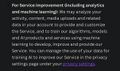 Canva's privacy policy about AI model training with user data.
 -
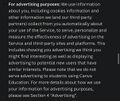 Canva's privacy policy on the usage of user data for personalized advertising


Business model
Canva is a freemium online graphic design suite that offers subscriptions for advanced features.[6] Canva's privacy policy admits to using user data for advertising and AI training purposes.[7][8]
Market control
Canva competes with the Adobe Creative Suite.[9] Canva is also popular due to its vast collection of accessible templates.[10]
Incidents
This is a list of all consumer-protection incidents this company is involved in. Any incidents not mentioned here can be found in the Canva category.
Data breach (2019)
- Main article: Canva 2019 data breach
On 24 May 2019, Canva identified their systems were attacked and posted an announcement about the breach, urging users to change their passwords.[11][12] 139 million users were affected, and information taken included user names, real names, e-mail addresses and location. 61 million users' data included password hashes, and for other users, Google tokens were taken.[13] Seven months later, on 11 January 2020, Canva became aware that four million user passwords had been decrypted and shared online. The following day, Canva forcibly reset the password of every user that had not changed it since the date of the incident.
Acquisition of Affinity editing suite (2024)
- Main article: Canva Affinity Studio adds arbitration clause
After Canva acquired Serif, the parent company of Affinity and respective software applications, the ability to purchase older versions of the software was removed and users were forced to utilize a Canva account (see forced account) along with the user agreement for the new software Affinity Studio.
Products
- Canva
- Affinity
- Remove.bg
See also
References
- ↑ "About Canva". Canva. Archived from the original on 16 Apr 2026. Retrieved 2 May 2026.
- ↑ "Welcome to Canva, Affinity!". Canva. 26 Mar 2024. Archived from the original on 16 Apr 2026. Retrieved 2 May 2026.
- ↑ "Canva Acquires Design Platform Affinity to Bring Professional Design Tools to Every Organization". Business Wire. 25 Mar 2024. Archived from the original on 16 Apr 2026. Retrieved 2 May 2026.
- ↑ Novet, Jordan (23 Feb 2026). "As Wall Street punishes software stocks over AI concerns, Canva gets more acquisitive". CNBC. Archived from the original on 16 Apr 2026. Retrieved 2 May 2026.
- ↑ "Privacy Policy". Canva. 15 Apr 2026. Archived from the original on 16 Apr 2026. Retrieved 2 May 2026.
- ↑ "Plans and pricing". Canva. Archived from the original on 16 Apr 2026. Retrieved 2 May 2026.
- ↑ "Canva - Trust Center - Privacy". Canva. Archived from the original on 16 Apr 2026. Retrieved 2 May 2026.
How does Canva improve its AI-powered features? [...] User content where this is consistent with their Privacy Settings for improving Canva's AI-powered features. [...]
- ↑ "Privacy Evaluation for Canva: Design, Photo & Video". Common Sense. 18 Sep 2023. Archived from the original on 16 Apr 2026. Retrieved 2 May 2026.
- ↑ "Online Graphic Design Software Market Size And Forecast". Verified Market Research. Mar 2026. Archived from the original on 16 Apr 2026. Retrieved 2 May 2026.
- ↑ Tshabalala, Zandile (3 Mar 2026). "The Canva Generation: Is Template Culture Changing Design?". 10and5. Archived from the original on 15 Apr 2026. Retrieved 2 May 2026.
- ↑ "Canva Security Incident – May 24 FAQs". Canva. 24 May 2019. Archived from the original on 16 Apr 2026. Retrieved 5 Mar 2026.
- ↑ "Canva Urges Users to Change Passwords After Cybersecurity Breach". Security Magazine. 30 May 2019. Archived from the original on 22 Aug 2019. Retrieved 2 May 2026.
- ↑ Hashim, Abeerah (31 May 2019). "Graphic Design Service Canva Suffers Data Breach Affecting 139 Million Users". Latest Hacking News. Archived from the original on 16 Apr 2026. Retrieved 2 May 2026.