.svg)
| Basic information | |
|---|---|
| Founded | 1976 |
| Legal Structure | Public |
| Industry | Electronics |
| Also known as | Apple, Inc |
| Official website | https://apple.com/ |
Apple is an American technology company that was founded in 1976 by Steve Jobs, Steve Wozniak and Ronald Wayne. It is best known for its consumer electronics, software, and services.
Apple's current product lineup include iPhones hardware such as the iPhone, iPad, Apple Watch, Mac, Apple Vision Pro, AirPods, and Apple TV; operating systems such as iOS, iPadOS, visionOS, and macOS; and various software and services including Apple Pay, iCloud, Apple Arcade, and multimedia streaming services like Apple Music and Apple TV+.
Consumer impact summary
Overview of concerns that arise from the conduct towards users of the product (if applicable):
- User freedom
- User privacy
- Business model
- Market control
Add your text below this box. Once this section is complete, delete this box by clicking on it and pressing backspace.
Incidents
This is a list of all consumer-protection incidents this company is involved in. Any incidents not mentioned here can be found in the Apple category.
Repairability of Apple products in the 2000s
Since the 2000s, Apple has focused on reducing the weight of its products as technology has advanced and become increasingly complex. This shift has contributed to challenges in repairing and upgrading their devices. Apple also became known for some design flaws and quality issues in the 2000s, including but not limited to:
- Sealing batteries in the iPods that lasted only 18 months, which led to a viral video protesting it.[1][2]
- iBook G3 and G4 models were notorious for GPU failures[3], with Apple acknowledging the G3 issue.[4]
- The eMac and iMac G5 suffered from capacitor plague and had replacement programs.[5][6]
- Certain configurations of the Power Mac G5 were liquid cooled, and would leak causing catastrophic damage.[7][8]
- The Titanium PowerBook G4 became notorious for hinge failures that increased in frequency as the laptops got older.[9]
Hardware design issues in the 2010s
Apple had numerous hardware design issues in the 2010s, often poorly acknowledged by the company and frequently charging exorbitant amounts for repair.
- High-cost GPU failures on early 2010's MacBooks[10]
- the 2016-'17 MacBook Pro's screen cable skimping scandal[11]
- 2016-2019 MacBooks butterfly keyboards[12]
- the 2019 16-inch MacBook Pro's SSD failures[13]
- The announcement and cancellation of Apple AirPower[14][15] speculated to have occurred due to overheating although Apple never confirmed this.[16][17]
Apple would also go out of their way to make their devices harder to repair.
- Gluing down batteries on Retina Macbooks, requiring specialized methods for removal.[18]
- Riveting down keyboards on palmrests, which can involve an entire palmrest replacement or messy repairs, depending on the model.[19]
- Part pairing on screens, fingerprint sensors, cameras, batteries, and vibration motors.[20][21][22]
- Screens that are sold as an entire assembly, and require complicated methods involving heat guns, art supply store spatulas, and special adhesives to replace just the panel.[23]
Recent attempts to do better
Recently, Apple has made efforts to improve its products, though some observers feel that its pro-consumer practices still do not match those of certain other manufacturers. This shift is thought by some to be influenced by evolving legislation.[24]
This includes:
- Opening an online Self Service Repair parts store.[25]
- Making the back glass of iPhones removable starting from iPhone 14.[26]
- Allowing alternative app stores in an update to iOS 17, in compliance with new EU legislation.[27]
- Calibration tools for newly installed used parts in iOS 18,[28] which sometimes work.[20]
- An upgradeable, swappable SSD in the 2024 Mac Mini - albeit you cannot swap these units between M4 and M4 Pro units due to the internal casing's design being different without much good reason.[29]
- A battery removable with just a 9V battery in the 2024 iPhone 16 and iPhone 16 Plus.[30]
- The MacBook Neo having modular USB-C ports, keyboards that aren't riveted, batteries that aren't glued, and not pairing parts to specific models.[31]
Many of these items have sparked allegations of malicious compliance and being introduced purely to make stricter right for repair legislation appear unnecessary to legislators while not doing much to improve the situation for consumers.
For instance, pricing for parts on the Self Service Repair store is virtually identical to having the part replaced by Apple themselves (including both the price of the part and labor)[32], alternate app installation options are limited to users in the European Union, still require developers to be registered with Apple, have them approve the apps and in many cases paying them fees, and the upgradeable SSDs do not use common standards such as M.2 NVME. Unlike standard SSDs, they are also not always swappable between different models and require access to a second Apple computer to provision after installation.
Operating system downgrades

It is not possible to upgrade or downgrade an iPhone, iPad, Apple TV, etc. to an Operating System (OS) version that is no longer signed by Apple. In most cases, only the most recent version is signed. Some exceptions exist, such as certain Apple TV models and Apple Silicon Macs. Downgrading the Apple TV 4K series is not possible at all due to the lack of a USB port. On Macs with a T2 chip, the user can select from three modes of secure boot:[33]
- No Security: Allow any OS to run (same as turning off secure boot on a PC).
- Medium Security: Allow any OS that is signed with a secure boot certificate (default, same as turning on secure boot on a PC).
- Full Security: Only allow the latest version of macOS, do not allow any other OS.
On Macs with Apple Silicon, the user can select from two modes of secure boot:
- Permissive Security: Accessible only via recovery Terminal tools (and still enforces Apple’s secure chain for much of the boot). This is the lowest available security policy on Apple silicon but does not remove secure boot entirely in the way "No Security" used to.
- Reduced Security: Allows booting older versions of macOS trusted by Apple but still enforces signed OS policy.
- Full Security: Only the currently signed macOS version trusted by Apple can boot.
iOS devices only support Full Security mode. The device checks for a cryptographic "ticket",[34] which are tied to the OS version and CPU serial number. These are provided by a server, which only provides them for the latest version (with very specific exceptions). The device refuses to boot if the ticket does not match. Workarounds exist, but with major caveats that are not viable for most users,[35] see the technical details on SHSH blobs.
Baseband signing incident (2026)
In July 2026, Apple abruptly stopped signing iOS baseband processor firmware versions for certain older iPhones and cellular iPads.[36] As iOS versions needed to be signed to prevent downgrading, this meant that restoring any of these devices was impossible without a backed up SHSH blob or until the signing issue was fixed. This affected the iPhone 4, 4s, 5, and 5c, along with several cellular variants of iPad models. While Apple did fix the 5c signing and other devices are presumably being fixed now, for a whole day these devices were unrecoverable.
Anyone trying to restore these devices was left with a bricked device, and posts were made about recovery failing.[37] This highlights a huge flaw with the recovery process for iOS devices as should the server ever go down or Apple disables signing SHSH blobs for later devices, the user is left with a brick if anything goes awry.
Class action lawsuit
Apple was the defendant of a class-action lawsuit with claims dating back to 2017 where users noticed their phones were being artificially slowed down. Apple agreed to settle the lawsuit for up to $500 million USD.[38] Apple claimed that this change was to benefit users who have old failing batteries, and that it wasn't for planned obsolescence.[39] They later published software updates and an article explaining how users can opt out of this new "performance management" mode.[40]
Once a new OS version is installed, there is no opportunity to go back. This also restricts the user's choice to jailbreak the device, as the latest version naturally has patches for the latest jailbreak exploits. App developers also require access to earlier iOS versions to test that their app works correctly. The alternative, Xcode's iOS Simulator, is not a complete replacement for real hardware, as it does not have all features of a physical device.[41] Instead, app developers are forced to purchase several test devices, and remember to never allow them to update.
Parts availability
Many parts are not available directly from Apple. Those that are available directly from Apple may be more expensive than paying Apple to repair your device.[citation needed - add citation with proof of this] Parts available to certified repair centers are extremely limited.[citation needed - proof if possible] Apple does not stock current generation iPad parts within GSX (See Certified Repair Centers). A limited selection of iPad parts are available from iFixit, however this can exclude some flex PCBs necessary for repairing headphone jacks.[citation needed - proof if possible]
If an Apple iPhone has GPS calibration issues and or Bluetooth connectivity issues, Apple will do their own diagnostics. You explain to the Apple employee how and when the issues occur and you explain in detail your methods to reproduce the issues. The issues occur when your phone is in your pocket while using navigation and when you hold your phone upside down while using your Apple Beats wireless headphones. After Apple runs their diagnostics and they are not able to detect the issues, they will move onto the next step which is fully resetting your device. This is considered a standard troubleshooting procedure. When you ask the Apple store manager if they would be willing to exchange your device for a similar model if they cannot fix your device they respond with "No, because these phones are designed to be fixed". After the software reset fail, Apple will require you to leave your phone with them so they can send it to their offsite repair facility for further diagnostics. After a few days, Apple will come to the conclusion that your phone requires an entire new midsection. When asked what was replaced, Apple will inform you that the entire inside has been replaced — essentially giving you a new phone (with a new IMEI, EID, etc.) apart from the casing and screen. [citation needed]
Pentalobe proprietary screws
Apple introduced pentalobe screws on the MacBook Pro in 2009, replacing standard Phillips screws with a five-lobed design not found in any standard toolkit. iFixit condemned the switch in January 2011, calling it a deliberate barrier to repair. [42]
Diagnostic software availability
Calibration software for some Apple devices has only recently become available to end users. End user calibration tools have only become accessible in iOS 18. Similar calibration tools have been available to Certified Repair Centers, but are generally limited as many parts are serialized, i.e. lid sensors on MacBooks. [citation needed]
Certified repair centers
Certified Repair Centers have some limited access to Apple's proprietary backend (GSX2). GSX contains many tools necessary to repair devices such as diagnostic tools, calibration tools, parts catalog, and device repair history. GSX is only accessible to repair centers Apple deems certified. GSX does not stock parts for iPads. It does not allow the calibration of parts such as lid sensors for a device, if that device does not have an open repair and purchased parts.[43] [citation needed - add an archive and properly cite this]The new iOS 18 calibration tool is very similar to Apple's ASU (GSX's diagnostic/calibration tool). Some videos of GSX can be found online. See: GSX - How to Gain GSX Apple Access - iOSGenius
Advertisements in first party apps
In 2014, Apple and the band U2 partnered to give all iTunes users a free digital copy of their newest album at the time, Songs of Innocence, which was marketed as "the biggest album release ever in history".[44] Many users who didn't want the album couldn't remove it from their iTunes library due to the album being listed as a "past purchase" on their account (however the album could always be "hidden").[45] Some reports speculated the deal was worth 100 million dollars and was done due to the band's declining popularity.[46] In 2022, Bono, a member of U2, wrote in his memoir how Tim Cook reportedly said how "there’s something not right about giving [U2's] art away for free" and "the whole point of what we’re trying to do at Apple is to not give away music free. The point is to make sure musicians get paid".[47]
In 2025, Apple added a promotional offer for F1 The Movie in their Wallet application.[48] Users have mentioned how this could violate Apple's own policy on advertising, how the high price of Apple devices shouldn't justify first party ads, and the annoyance of seeing it.[49] For users on the iOS 26 beta, there is an option to disable "Offers & Promotions", with users on iOS 18 needing to disable notifications completely for the Wallet app.[50]
-
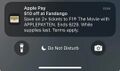 Notification of the offer
 -
 Home screen of Wallet app
 -
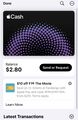 Apple Cash card screen
 -
 Screen when selecting "learn more"
.jpg)
.jpg)
.jpg)
.png)
AirDrop censorship (2022)
- Main article: AirDrop Hong Kong censorship

As a result of the 2019 Hong Kong protests, Apple was pressured by the Chinese government to set a time limit for the AirDrop "everyone" option for iPhones due to its impact at scheduling protests against the government to avoid censorship.[51]
In 2023, the setting was applied to all iPhones worldwide to "mitigate unwanted file sharing", meaning users will need to set their airdrop setting manually every ten minutes instead of leaving it on permanently, leaving the only other options as "contacts only" and "receiving off".[52]
"Peanuts" TV Special Takeover
In late October of 2020, Apple announced that its Apple TV+ service had become the exclusive home of the library of classic Peanuts animated specials, including A Charlie Brown Christmas, It's the Great Pumpkin, Charlie Brown, and A Charlie Brown Thanksgiving. For almost 50 years, these beloved specials were shown once a year on free over-the-air TV, but as of 2020, anybody who wishes to watch them is now required to own a device that offers the Apple TV+ service and an active Apple TV+ subscription.[53]
2024 Antitrust Lawsuit
In March 2024, the United States Department of Justice filed a lawsuit against Apple claiming that the "closed garden" ecosystem Apple creates surrounding its iPhones stifles competition and innovation. The lawsuit alleges that Apple is directly forcing customers to purchase and use iPhones and their accessories and software in several ways:
- Forcing mobile carriers including AT&T, Verizon, and T-Mobile to offer its best customer deals exclusively to those who purchase iPhones.
- Restricting the functionality of Super apps such as WeChat.
- Forcing in-app purchases through applications such as Fortnite to be made within the App Store and taking a part of the proceeds as commission pay.
- Restricting the use of third-party digital wallets and requiring users to exclusively use Apple Pay.
- Restricting how third-party message apps can interact with iMessage.
- Restricting their HomeKit home automation system and all compatible devices to work only on Apple's products and issuing cease & desist orders against emulators designed to make HomeKit compatible with third-party products.
- Restricting compatibility of third party smart watches.[54][citation needed - make sure the source beside this is the actual antitrust case.]
Apple is expected to go to trial in early 2027.[55]
European Union USB-C Directive 2022/2380
As part of Directive (EU) 2022/2380, the European Union mandated that all smartphones, tablets, digital cameras, headphones, and other portable electronic devices must utilize USB-C as a universal charging standard by the end of 2024, with laptops following by 2026. [56]
This regulatory measure directly addresses consumer frustration with incompatible chargers types and aims to significantly reduce electronic waste. [57] The legislation allows manufacturers to unbundle chargers from devices, potentially saving consumers money, and ensures charging speed harmonization across compatible devices.
While Apple initially opposed the standardization, arguing that it would "stifle innovation rather than encourage it," the company ultimately conceded defeat, with Apple's head of marketing stating "we have no choice" regarding compliance. [24]
European Digital Markets Act
- Main article: Digital Markets Act
This law forced many companies including Apple to change the way they operate to create a fairer competition.
Changes Apple introduced iOS and iPadOS to comply with this law:
- Introduced the ability to install applications from alternative marketplaces
- asks which browser and search engine should be the default one
- Developers now are allowed to publish browsers that do not use webkit in the EU.
Controversies:
- Apple removed iPhone torrenting app iTorrent from alternative marketplace AltStore PAL, developer said that the access was revoked "without any warning". In a statement to The Verge, Apple spokesperson Peter Ajemian said:
“Notarization for this app was removed in order to comply with government sanctions-related rules in various jurisdictions. We have communicated this to the developer.”[58]
Elon Musk Lawsuit
In August of 2025, businessman Elon Musk accused Apple of engaging in anti-competitive practices by only allowing OpenAI’s ChatGPT to reach the top of the sales chart on Apple App Store. He announced his plan to sue Apple for this practice.[59]
Greenwashing
Apple claims to be environmentally friendly and invests significant amounts of funds in corresponding PR campaigns,[60] but the reality is not quite as green.
Customers are lead to think that their purchases and frequent replacement of their devices do not have a negative impact on the environment, which is not the case.
In autumn of 2025, stricter EU regulations on misleading marketing claims and a lawsuit by German environmental and consumer protection non-profit organization Deutsche Umwelthilfe have forced Apple to remove their claim of carbon neutrality on several products on their EU websites. Affected products include the Apple Watch 3 and Apple Watch Series 11.[61]
Green energy pooling
Apple shares manufacturing capacity at several Taiwan based companies including but not limited to TSMC, Foxconn and Pegatron. If Apple uses a hypothetical 20% of their manufacturing capacity, and company B, C, D, and E also each take up 20%, and the company doing the manufacturing runs on 20% renewably generated energy, now Apple as well as companies B, C, D, and E will each publicly claim that their manufacturing runs 100% on renewable energy. In other words, each company will claim the 20% renewable energy was used for their production.[62]
CO2 Certificates and forest projects
…
The packaging trick
Apple, like many companies, regularly emphasises how environmentally friendly their packaging is and highlight advancements in this area.[63]
This deliberately distracts from the fact that only a negligible fraction of the environmental footprint of an electronic device comes from the packaging, as it is made of significant amounts or rare earth minerals, metals and mined components and consuming vast amounts of energy, water and fuel in manufacturing and transport.
Some of the environmental advancements touted by Apple could also be argued to be environmentally beneficial side effects of purely economic decisions aimed at maximizing profit, such as shipping iPhones without chargers.[64]
Shredding vast amounts of fully functional devices
In 2020, it came to light that Apple had filed a lawsuit against a recycling company, revealing that 100,000 iPhones had been illegitimately shipped to China to be sold there instead of being shredded as had been agreed with Apple.[65][66]
These devices were likely trade-in devices from people who received a discount on a new model in exchange. Bloomberg News writes, referring to the contract with the recycler:[67]
Even if the iPhones looked good enough for resale, Apple Inc.’s contract with GEEP (said with a hard “g”) explicitly required that every product it sent be destroyed.
Used iPhone that are sold on the used market are a direct competition to new sales by Apple. Apple likely does not want the public to know about these processes, since security seems to be tight around the shredding process:
In some cases, Apple hired outside security consultants to escort trucks to its recyclers and monitor the destruction process, which the tech giant could further analyze through data reports charting scrap weights and commodity yields to ensure the input matched the output.[68]
Apple later retreated the lawsuit,[68] leading to speculation that it wanted to avoid having to disclose how many devices they are really having shredded.
iPhone recycling robot initiative
The first iteration of Apple's iPhone recycling robot, designed for the iPhone 6, was never more than a publicity stunt, according to an article by Bloomberg:[67]
Liam’s precision automation, however, proved a dead end. It could handle just one iPhone model, and not that well. If a device had corroded screws or sticky insides, the robot would glitch. A person familiar with the project estimates Liam could run for about 10 minutes without human intervention. Another person says Apple at times fed the robot still-functioning iPhones and, for media demos, cherry-picked cleaner units so it didn’t crash, suggesting Liam was geared more for promotion than scalability.
The same article cites industry insider claiming that the new iteration of the robot is only able to recycle as many devices in a year as Apple sells in just 48 hours.[67] Thus, it can be assumed that the vast majority of trade-in devices are simply shredded.
OS-Level age verification
- Main article: Apple introduces OS-level age verification

On February 25, 2026, Apple rolled out the iOS Beta version 26.4, in order to comply with the Online Safety Act and other similar normatives. This version contains an Age verification system built on the operating system, blocking content that could be considered as "mature", including websites. It will be rolled on the UK, Brazil, Australia, Singapore and US states of Louisiana and Utah. Site and content blocking cannot be bypassed by VPNs as the restrictions are in the operating system itself. The current only way to prevent being blocked is by verifying by submitting info of an existing credit card. [69]
OCSP Controversy
- Main article: Gatekeeper
In late 2020, an issue left the domain 'ocsp.apple.com' unreachable for certain Mac users, many of whom experienced unresponsiveness and apps taking minutes to launch. Soon after, users found errors related to the 'trustd' process, responsible for app notarization verification, which was repeatedly attempting to contact the OCSP server but failed.[70] Mass concern heightened as posts like "Your Computer isn't yours" noted that these OCSP requests were unencrypted and could potentially allow ISPs and other parties to view traffic, as well as allow Apple to potentially build detailed profiles on their users based on every app a user opened and "minute-by-minute usage." [71] Apple responded by assuring users that data from these checks had never been combined with information about Apple users or their devices and that it is not used to learn about what users are running on their devices.[72]
Hide My E-Mail security flaws (2025–2026)
Apple's service for providing anonymous logins to online services had a critical security flaw which allowed anyone to de-anonymize addresses and retrieve the original e-mail address behind the login.
All an attacker had to do was to send an e-mail they knew would be classified as spam. The bounce message the Apple servers then returned contained the original e-mail address behind the account.
Apple was made aware of the issue in June 2025, but took until June 2026 to deploy a first fix which turned out to still be ineffective. After another ineffective fix followed a few weeks later. Only after media outlets were informed, Apple finally fixed the problem.[73][74]
All cccount e-mail addresses created up until that point have to be considered compromized.
Products
See also
References
- ↑ Broersma, Matthew (2003-11-26). "IPod's 'dirty secret' wins Web fans". ZDNet.
- ↑ Neistat, Casey (2003). "iPod's Dirty Secret". YouTube.
- ↑ Staff, CNET (2005-11-29). "iBook G4 Logic board failures (#2): AppleCare coverage; Replacements failing as well in some cases; more". CNET. Retrieved 2026-07-09.
{{cite web}}: CS1 maint: url-status (link) - ↑ "Expanded iBook Logic Board Repair Extension Program Frequently Asked Questions". Apple. 2004-12-17. Retrieved 2006-02-06.
{{cite web}}: CS1 maint: url-status (link) - ↑ "iMac G5 Repair Extension Program for Video and Power Issues". Apple. Retrieved 2006-02-06.
- ↑ "eMac Repair Extension Program for Video and Power Issues". Apple. Retrieved 2007-08-23.
- ↑ Staff, CNET (2007-08-28). "The case of the leaky Mac: Power Mac G5 (liquid-cooled) coolant leaks". CNET. Retrieved 2026-07-09.
- ↑ "Which Power Mac G5 models use liquid cooling? Which Power Mac G5 models have been reported to have problems with the liquid cooling system?". EveryMac. 2008-08-17. Retrieved 2026-07-09.
{{cite web}}: CS1 maint: url-status (link) - ↑ "Charnière Titane (G4)". powerbook-fr.com. Retrieved 2005-10-14.
- ↑ "Apple faces class-action lawsuit over 2011 MacBook Pro GPU issues". 9to5mac. 2014-10-28. Archived from the original on 2025-10-10. Retrieved 2025-10-26.
- ↑ Porter, Jon (2019-05-05). "Apple quietly addressed 'Flexgate' issue with MacBook Pro redesign". The Verge. Archived from the original on 2025-12-24. Retrieved 2025-10-26.
- ↑ Bohn, Dieter (2020-05-04). "The saga of Apple's bad butterfly MacBook keyboards is finally over". The Verge. Archived from the original on 2026-01-28. Retrieved 2025-10-26.
- ↑ digilloyd (2020-04-03). "2019 MacBook Pro Seems to Have a High Failure Rate". Mac Performance Guide. Archived from the original on 2025-07-08. Retrieved 2025-10-26.
- ↑ Panzarino, Matthew. "Apple cancels AirPower product, citing inability to meet its high standards for hardware". TechCrunch. Archived from the original on 2019-04-01.
- ↑ Clover, Juli (2018-09-12). "After No Sign of AirPower at Today's Event Apple Wipes Most Mentions From Website". MacRumors. Archived from the original on 2021-11-24. Retrieved 2025-10-26.
- ↑ Gallagher, William (18 Jun 2020). "Apple has reportedly solved the AirPower overheating problem". appleinsider. Archived from the original on 21 Jun 2026.
- ↑ Lloyd, Craig (29 Mar 2019). "What Finally Killed AirPower". iFixit. Archived from the original on 21 Jun 2026.
- ↑ Davis, Ron (2015-03-11). "MacBook Pro 13" Retina Display Early 2015 Teardown". ifixit. Archived from the original on 2026-04-23.
- ↑ "MacBook Air 13" Mid 2012 Keyboard Replacement". ifixit. 2026-05-13. Archived from the original on 2026-07-09. Retrieved 2026-07-09.
{{cite web}}:|first=missing|last=(help) - ↑ 20.0 20.1 Chamberlain, Elizabeth (18 Sep 2024). "The End of Parts Pairing? Almost". iFixit. Archived from the original on 21 Jun 2026.
- ↑ Wiens, Kyle (2023-09-25). "iPhone 15 Teardown Reveals Software Lockdown". ifixit. Archived from the original on 2026-07-06.
- ↑ Mickle, Tripp; Koeze, Ella; Chen, Brian X. (Nov 12, 2023). "You Paid $1,000 for an iPhone, but Apple Still Controls It". The New York Times. Archived from the original on Feb 29, 2024.
- ↑ Rossmann, Louis (2016-04-19). "How to replace A1466 Macbook Air screen updated video". Retrieved 2026-07-09.
{{cite web}}: CS1 maint: url-status (link) - ↑ 24.0 24.1 Hern, Alex (2022-10-26). "Apple to put USB-C connectors in iPhones to comply with EU rules". The Guardian. Archived from the original on 2026-02-12. Retrieved 2025-10-26.
- ↑ "Apple announces Self Service Repair". Apple Newsroom. 2021-11-17. Archived from the original on 2026-02-03. Retrieved 2026-03-08.
- ↑ Wiens, Kyle (2022-09-16). "Inside Apple's Secret iPhone 14 Redesign". iFixIt. Archived from the original on 2026-01-16. Retrieved 2025-10-26.
- ↑ "Installing apps through alternative app distribution in the European Union". support.apple.com. Archived from the original on 2025-12-23. Retrieved 2025-10-26.
- ↑ "Use Repair Assistant to finish an iPhone or iPad repair". support.apple.com. Archived from the original on 2026-02-08. Retrieved 2025-10-26.
- ↑ Sorrel, Charlie (2024-11-12). "All Hail the Return of Upgradeable Storage! Mac mini 2024 Teardown". iFixit. Archived from the original on 2025-11-16. Retrieved 2025-10-26.
- ↑ "iPhone 16 Plus Battery". support.apple.com. Archived from the original on 2025-10-18. Retrieved 2025-10-26.
- ↑ Chamberlain, Elizabeth (2026-03-13). "MacBook Neo Is the Most Repairable MacBook in 14 Years". ifixit. Archived from the original on 2026-06-05. Retrieved 2026-07-09.
- ↑ Ganapini, Cristina (2022-12-06). "Apple's self-repair programme is not the Right to Repair we need". Right to Repair Europe. Archived from the original on 2026-02-09. Retrieved 2026-03-08.
- ↑ "About Startup Security Utility on a Mac with the Apple T2 Security Chip". Apple. Archived from the original on 7 Jun 2025. Retrieved 22 Jun 2025.
- ↑ "APTicket". theapplewiki.com. 2024-11-20. Archived from the original on 2026-02-16. Retrieved 2025-10-26.
- ↑ "Firmware rendering". theapplewiki.com. 2021-09-27. Archived from the original on 2025-10-21. Retrieved 2025-10-26.
- ↑ Mendes, Marcus (9 Jul 2026). "Apple stops signing iOS versions for several older iPhones and iPads [U: Signing restored]". 9to5mac. Archived from the original on 9 Jul 2026. Retrieved 9 Jul 2026.
- ↑ iPhone4SUser613 (9 Jul 2026). "I am unable to restore my iPhone 5 with my iOS 6.1.4 blobs on LiK". Reddit. Archived from the original on 9 Jul 2026. Retrieved 9 Jul 2026.
{{cite web}}: CS1 maint: numeric names: authors list (link) - ↑ Cooper, Gael (9 Jan 2024). "Apple Starts Sending Out iPhone 'Batterygate' Settlement Payments. What to Know". CNET. Archived from the original on 21 Mar 2025. Retrieved 22 Jun 2025.
- ↑ Napolitano, Elizabeth (2023-08-18). "Millions of Apple customers to get payments of up to $90 in iPhone "batterygate" settlement. Here's what to know". CBS News. Archived from the original on 28 Dec 2025.
- ↑ "iPhone battery and performance". Apple. Archived from the original on 18 Jun 2025. Retrieved 22 Jun 2025.
- ↑ Vajpai, Shreeti (24 Jun 2024). "iOS Emulators / Simulators vs Real iOS Devices". ContextQA. Archived from the original on 19 May 2025. Retrieved 22 Jun 2025.
- ↑ Wiens, Kyle (20 January 2011). "Apple's Diabolical Plan to Screw Your iPhone". IFIXIT. Archived from the original on 24 April 2026. Retrieved 3 June 2026.
- ↑ "GSX - How to Gain GSX Apple Access - iOSGenius". YouTube. 7 Jan 2017. Archived from the original on 22 Jun 2026.
- ↑ "Apple & U2 Release "Songs of Innocence" Exclusively for iTunes Store Customers". Apple Newsroom. 2014-09-09. Archived from the original on 2025-04-05. Retrieved 2025-06-25.
- ↑ Assar, Vijith (2014-09-16). "Apple's Devious U2 Album Giveaway Is Even Worse Than Spam". WIRED. Archived from the original on 2025-05-30. Retrieved 2025-06-25.
- ↑ Rott, Nathan (2014-09-15). "Apple's U2 Album Promotion Backfires". NPR. Archived from the original on 2025-06-01. Retrieved 2025-06-25.
- ↑ Bove, Tristan (2022-10-24). "Apple CEO Tim Cook thought U2 putting its album on your iPhone was 'not right'—even though he did it anyway". Fortune. Archived from the original on 2025-01-27. Retrieved 2025-06-25.
- ↑ "F1 The Movie - News". Apple TV+ Press. Archived from the original on 2025-11-09. Retrieved 2025-10-26.
- ↑ u/african-nightmare (2025-06-24). "Getting ads in Apple Wallet, how to disable?". Reddit. Archived from the original on 2025-07-25. Retrieved 2025-06-25.
- ↑ Perez, Sarah (2025-06-24). "iPhone customers upset by Apple Wallet ad pushing 'F1' movie". TechCrunch. Archived from the original on 2025-06-24. Retrieved 2025-06-25.
- ↑ Weatherbed, Jess (2022-11-10). "Apple limits AirDrop in China after its use in protests". The Verge. Archived from the original on 2025-07-23. Retrieved 2025-08-24.
- ↑ Hall, Zac (2025-03-17). "Apple globally censoring this iPhone communication feature deserves renewed scrutiny". 9To5Mac. Archived from the original on 2025-07-23. Retrieved 2025-08-24.
- ↑ Adalian, Josef (2020-10-19). "Apple TV+ Says: Welcome, Great Pumpkin". Vulture. Archived from the original on 2025-12-08. Retrieved 2025-11-05.
- ↑ "U.S and Plaintiff States v. Apple Inc". United States Department of Justice. 2024-03-21. Archived from the original on 2026-02-21. Retrieved 2026-03-11.
- ↑ Liedtke, Michael (2025-06-30). "Judge allows antitrust lawsuit against Apple to proceed". Associated Press. Archived from the original on 2026-02-05. Retrieved 2025-07-14.
- ↑ "Directive (EU) 2022/2380 of the European Parliament and of the Council of 23 November 2022 amending Directive 2014/53/EU on the harmonisation of the laws of the Member States relating to the making available on the market of radio equipment (Text with EEA relevance)". EUR-Lex. 2022-12-07. Archived from the original on 2025-08-17. Retrieved 2025-09-02.
- ↑ "USB-C-Standard: Schluss mit dem Kabelwirrwarr". zdfheute. 2024-12-28. Archived from the original on 15 Feb 2026. Retrieved 2025-09-02.
- ↑ Weatherbed, Jess (August 28, 2025). "Apple pulls iPhone torrent app from AltStore PAL in Europe". The Verge. Archived from the original on September 3, 2025.
- ↑ Durden, Tyler (2025-08-12). "Musk Accuses Apple Of "Unequivocal Antitrust Violation" For Favoring OpenAI In App Store Rankings". ZeroHedge. Archived from the original on 2025-10-29. Retrieved 2025-08-14.
- ↑ "Environment | Mother Nature". Apple. Archived from the original on 2025-09-28. Retrieved 2025-09-15.
- ↑ Schwan, Ben (2025-11-26). "Wegen EU-Regeln: Apple zieht Klimaneutralitäts-Claim zurück [Due to EU regulations: Apple retracts claim of climate neutrality]". Heise Online. Archived from the original on 2026-01-29. Retrieved 2025-11-26.
- ↑ Gieselmann, Hartmut (2023). "Von wegen CO2-neutral – Umweltexperten werfen Apple Greenwashing vor". c't Magazin für Computertechnik [Germany]. 2023 (23): 49. Archived from the original on 2025-11-04.
- ↑ "Apple 2030 – We've reduced our emissions by over 60%". Apple. Archived from the original on 2025-09-10. Retrieved 2025-09-15.
- ↑ Dragan, Lauren (2023-09-12). "iPhones No Longer Come With a Charger or Headphones. Here's What to Get If You Need Them". The New York Times. Archived from the original on 2025-07-31. Retrieved 2025-10-26.
- ↑ Lovejoy, Ben (2024-04-24). "100,000 iPhones stolen instead of scrapped; Apple accused of shredding usable devices". 9to5mac. Archived from the original on 2025-07-25. Retrieved 2025-09-16.
- ↑ Carrique, Felicitas (2020-10-04). "Apple sues recycling partner for reselling more than 100,000 iPhones, iPads, and Watches it was hired to dismantle". The Verge. Archived from the original on 2026-01-01. Retrieved 2025-09-16.
- ↑ 67.0 67.1 67.2 Carr, Austin (2024-04-18). "What Really Happens When You Trade In an iPhone at the Apple Store". Bloomberg. Archived from the original on 29 Aug 2025. Retrieved 2025-09-16.
- ↑ 68.0 68.1 Carr, Austin (2025-03-17). "Apple Drops Lawsuit Against Recycler in Mystery of Missing iPhones". Bloomberg News. Archived from the original on 2025-08-29. Retrieved 2025-09-16.
- ↑ "Age requirements for apps distributed in Brazil, Australia, Singapore, Utah, and Louisiana". Apple Devloper. February 24, 2026. Archived from the original on February 28, 2026. Retrieved 2026-03-06.
- ↑ Axon, Samuel; Hutchinson, Lee (12 Nov 2020). "macOS Big Sur launch appears to cause temporary slowdown in even non-Big Sur Macs". Ars Technica. Archived from the original on 21 Jun 2026.
- ↑ Goodin, Dan (16 Nov 2020). "Mac certificate check stokes fears that Apple logs every app you run". Ars Technica. Archived from the original on 21 Jun 2026.
- ↑ Paul, Jeffrey (12 Nov 2020). "Your Computer Isn't Yours". sneak.berlin. Archived from the original on 21 Jun 2026.
- ↑ Sokolov, Daniel AJ (2026-07-21). "Apple fixes Hide my Email on third try". Heise Online. Retrieved 2026-07-22.
- ↑ Cox, Joseph (2026-07-21). "Apple Fixes Hide My Email Vulnerability After 404 Media Coverage". 404 Media. Retrieved 2026-07-22.